
Image by Tara Winstead from Pexels
Finding ways you might not realize to manage your daily routine.

Routine = structure
They’re the building blocks of all you do in a day, like what you eat and the work you do.
Yet, many don’t understand how to organize their time for what’s best for them. Thinking that you have to be tired at the end of the day in order to be “productive.”
That’s not the case whatsoever.
You can have a routine that **energizes you, not exhaust****s and here’s how!
Self-awareness
If you’re a solopreneur, especially a remote one, you may remember how difficult it was when quitting your 9–5 to pursue your solo biz.
Not only were you not told when to clock in and out, but you were needing to do everything on your own:
- Schedule meetings
- Design or build products**-** Build a social media presence
This all requires great self-discipline to work, instead of diving right into the couch.
Self-awareness helps us plan ahead of time before we start feeling overwhelmed.
How? By giving you a bird’s eye view of what you do during the day & understanding when the best time for both your productivity and health is to do it.
This can be done by planning ahead in a scheduling app like:
- Notion
- Asana
- Monday
- Google Calendar
But understanding how to schedule your time takes understanding how your energy moves during the day, too.
Energy Oscillations
Your energy never stays the same.
Like an oscillating graph, it goes up and down depending on the last time you ate & even when you exercised.
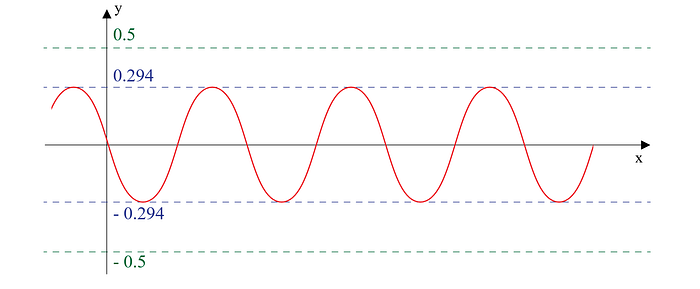
Image from University of Guelph
Understanding how your energy moves is crucial to building your own routine.
How? By helping you be more flexible with your time so you don’t burn out.
Personally, I organize my time into two energies:
- Light work
- Deep work
I talk more about this in my article here, but the gist is that light work is for light focus activities (when you’re least energized), and deep work is for deep focus activities (when you have the most energy during the day).
Part of understanding your personal oscillations is by tracking them in an app, like the ones I mentioned.
I use this Notion template called the Energy OS to do this, which helps me tag what’s a light work & deep work activity.
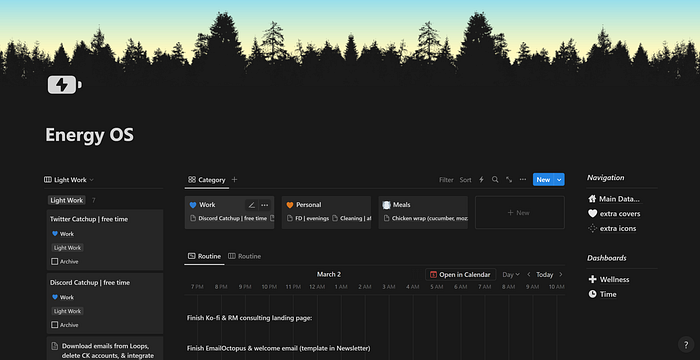
Image taken by author
Personally, here’s what my oscillations look like:
6–8 am: Light work 8 am: Meal time
9 am-12 pm: Deep work 12 pm: Meal time
1–3 pm: Deep work 4–6 pm: Light work
6 pm: Meal time
The afternoon’s used to be a time for me when I could only do light work tasks. But recently after I realized that I wanted to have more energy to work in the afternoon’s, I switched my coffee time to 1 pm since I’m naturally energized in the morning, which has been working well!
This may look a lot like your oscillations, but it may differ if you’re a night owl, for example.
Takeaway
Routine is the structure to your day.
It provides a base for all other tasks to build on, which makes it important to make note of — especially if you’re a solopreneur.
As someone who’s been studying remotely for over 4 years, I’ve been able to build a routine that helps me to be my best productive self, without feeling exhausted in all my solopreneur activities.
That’s why I want to share these strategies on how solopreneurs can be energized during their day, so that they can keep working without losing their passion and burning out _(_like the lil’ guy on the cover image 💀)